
How to Stop Swim Goggles Fogging (Methods That Actually Work)

How to Stop Swim Goggles Fogging (Methods That Actually Work)

Goggle fog is condensation, not dirt. Warm, moist air from your face hits the cooler lens, and water vapour turns into tiny droplets that scatter light. The bigger the temperature gap, the worse the fog, which is why cold pools and open water are especially cruel. The good news: you can stop most fog by protecting the factory coating or adding a thin surfactant layer. Here is how to do both.

Why goggles fog

Your face sits at roughly 37 °C (98.6 °F), while pool water can sit anywhere from 20 to 27 °C (68 to 81 °F). That temperature drop pulls moisture out of the air trapped inside the goggle and onto the lens. Dust and oil on the lens give those droplets something to cling to, so a dirty lens fogs faster. Factory anti-fog coatings fight this by spreading water into a thin, clear film instead of letting it bead up. The coating is fragile, though. Once it is gone, fog returns fast.

New goggles usually stay fog-free longer; once the factory coating wears, most swimmers need a surfactant treatment. Coating care is the single biggest factor.

What you will need
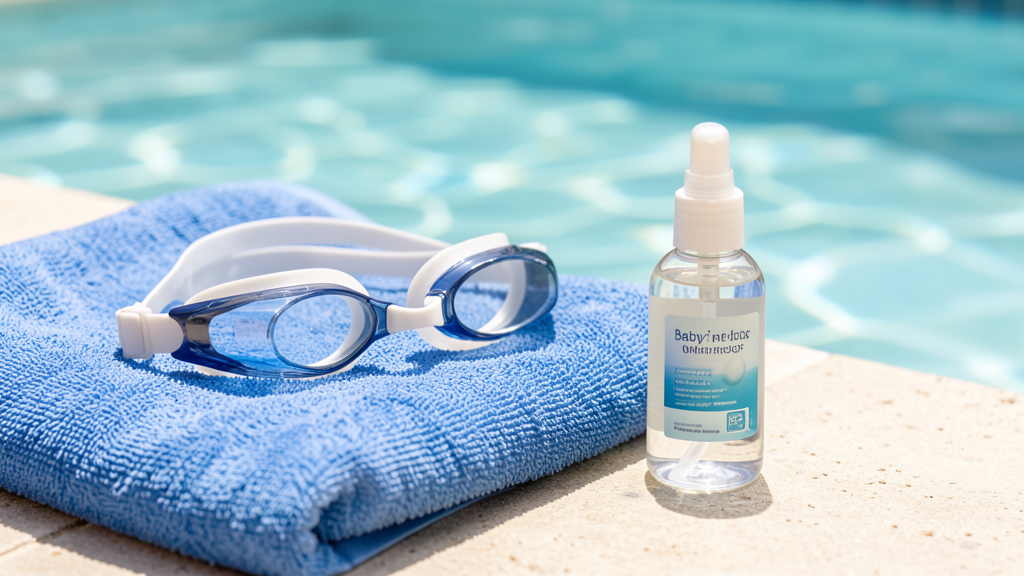
Swim goggles, a small bottle of baby shampoo, and a poolside towel arranged as anti-fog essentials.
Basic anti-fog setup with goggles, baby shampoo, and a towel.

Step 1: Rinse, do not rub

After every swim, rinse the goggles in fresh cool water. Hold them under the tap or slosh water through the lenses. Let water do the cleaning.

Do not wipe the inside of the lenses with your finger, a towel, or a microfiber cloth. Rubbing strips the hydrophilic coating. Even a gentle swipe can turn a coating that lasts months into one that lasts weeks. If something is stuck inside a lens, rinse it again. If it still will not move, the coating may already be damaged and you should switch to a surfactant method instead of scrubbing.

Step 2: Pre-wet before you put them on

Before the first lap, dip the goggles in the pool or splash water on the inside of the lenses. Pre-wetting does two things. A thin water film on the inside of the lens makes condensation spread into a clear sheet rather than beading into droplets, and it activates any remaining factory coating so it can spread moisture into a clear film.

This step is especially useful in cold water or when you step from a warm deck into a cooler pool. It will not last the whole session, but it buys you the first few minutes.

Step 3: Add a surfactant layer if the coating is gone

If your goggles fog no matter how well you rinse them, the factory coating has probably worn off. A surfactant breaks the surface tension so water spreads instead of beading. Pick the method that fits your budget, hygiene tolerance, and eyes.

Saliva

Spit or lick the inside of the lens, spread it into a thin layer with a clean fingertip, then give the goggles a brief rinse. Saliva is free and always available, and many swimmers find it surprisingly reliable. The trade-offs: it is short-lived, it can need reapplication mid-session, and it is not the most hygienic choice in a crowded lane.

Baby shampoo

Put a small drop of no-tears baby shampoo on each inside lens. Spread it gently with a clean fingertip and let it sit for 20 to 30 seconds. Then rinse lightly so a thin film remains. Many athletes dilute a few drops in a small spray bottle of water. With careful application, baby shampoo works well for many swimmers. It is also the gentlest option for sensitive eyes.

Commercial anti-fog spray, drops, or wipes

Sprays and drops work the same way as shampoo: they leave a thin hydrophilic film. Spray the inside of the lens, spread it, wait a few seconds, then rinse lightly before swimming. Wipes can work well on older goggles. They are the most expensive per use and can damage the remaining coating on newer goggles, so save wipes for goggles whose factory coating is already gone.

Step 4: Rinse lightly

Whether you use saliva, shampoo, or a commercial treatment, the goal is a thin residue, not a soapy puddle. Rinse the goggles briefly under cool water and shake off the excess. If you rinse too aggressively, you wash away the surfactant and the fog comes back.

Step 5: Put them on with a good seal

A loose goggle traps warm air and lets it churn against the lens. Press the frames gently against your eye sockets, then pull the strap into place so the seal stays even without being tight enough to leave deep marks. Once the goggles are seated, avoid lifting them onto your forehead. That turns the strap into a hot, sweaty bridge and pumps moisture back onto the lenses.

Step 6: Dry and store carefully

When the session is over, shake out the water and let the goggles air dry. Store them in a hard case or soft pouch, lens-side up, away from rough objects like kickboards or fins. Keep them out of direct hot sun. Heat accelerates coating breakdown and can warp softer gaskets over time.
White swim goggles and a blue swim cap resting on a wet poolside surface.
In-article detail image: goggles and cap on a wet poolside surface after a session.

What not to do

  • Do not wipe the inside lens. Fingers, towels, and cloths all strip the coating.
  • Skip toothpaste. It is abrasive and scratches polycarbonate lenses. The idea comes from scuba diving, where glass masks have no coating. It does not transfer to swim goggles.
  • Skip vinegar. The acid can damage plastic lenses.
  • Skip shaving cream. It can work in a pinch, but it is easy to leave a filmy residue that reduces clarity if you do not rinse thoroughly.
  • Do not use anti-fog wipes on brand-new goggles. They are effective on worn lenses, but they can strip a fresh factory coating.
  • Do not leave goggles loose in your bag or on the dashboard. Heat, pressure, and abrasion all shorten coating life.

Quick fixes by situation

  • Brand-new goggles fog right away: Pre-wet them or add saliva and wait a minute. Early fog is usually transient temperature shock, not a failed coating.
  • Coating still intact but fog creeping in: Rinse only, then pre-wet before the next set. Do not add sprays or wipes yet.
  • Chronic fog after a month of regular use: The coating is probably gone. Switch to baby shampoo or a commercial spray and reapply every one to three swims.
  • Race day, one application only: A single-use wipe can give max clarity for one session, but save it for older goggles.
  • Sensitive eyes: Baby shampoo is generally the gentlest. If you use a commercial product, rinse thoroughly and avoid ingredients that have irritated you before.

FAQ

Why do new goggles sometimes fog?

Even new lenses can fog when you first jump into cold water. The warm air inside the goggle hits the cold lens and condenses. Once the microclimate inside the goggle balances, the fog often clears on its own. Pre-wetting helps prevent that first burst.

How long does a factory anti-fog coating last?

With careful rinsing and storage, most factory coatings last a few weeks to a few months of regular use. Wiping the inside lens, using harsh cleaners, or leaving goggles in a hot car can cut that to a few weeks.

Is spit really effective?

Yes, many swimmers find it works as well as most commercial sprays and shampoos. The catch is that it does not last as long. It is a great backup in a pinch, not a long-term replacement for a good coating or treatment.

Can I restore a worn coating?

You cannot rebuild the factory coating at home. Once it is gone, the best option is to maintain a thin surfactant film with baby shampoo or a commercial anti-fog treatment. Treat the goggles every one to three swims depending on how hard the session is on the lens.

Why does cold water make fog worse?

Cold water cools the outside of the lens more than warm water does. That bigger temperature gap pulls more moisture out of the air inside the goggle, so droplets form faster.

Bottom line

Protect the factory coating first: rinse gently, do not rub, and store your goggles in a case. When the coating eventually wears out, switch to a thin surfactant film. Baby shampoo is cheap and gentle, and many swimmers find it works about as well as most sprays. Saliva works in a pinch. Wipes are strong for one-off sessions but expensive and harsh on newer lenses. Pick the method that matches your pool, your budget, and how often you swim, and fog becomes a problem you solve in ten seconds before you push off the wall.


Elite Swimmer HQ is reader-supported. As an Amazon Associate I earn from qualifying purchases. When you buy through links on our site, we may earn an affiliate commission at no extra cost to you.

Tumble turn drills for beginners

The tumble turn is the skill most adult swimmers avoid, usually because the first few attempts end in a noseful of water. But broken into small steps, it is very learnable. Here is a progression that builds confidence before you ever touch the wall fast.

Step 1: Forward rolls in the middle of the pool

Away from the wall, practise simple forward somersaults. Tuck tight, blow bubbles out of your nose so water does not rush in, and come back to your feet. Do these until they feel relaxed.

Step 2: Roll and find the wall

Swim slowly into the wall, roll, and plant both feet flat on it. Do not push off yet. Just get used to finishing the rotation in the right place with your feet set.

Step 3: Roll and push off on your back

Add a gentle push off into a streamline on your back, then rotate onto your front as you glide. Keep it slow and smooth.

Step 4: Build speed

Only now start swimming in faster, carrying momentum into the flip. Speed actually makes the rotation easier once the technique is there.

The quick version

  • Blow out through your nose the whole time.
  • Master the roll away from the wall first.
  • Plant both feet, push off in a streamline.
  • Add speed last, once it feels natural.

Spend a session on each step. Rushing straight to a fast flip is what puts people off. Build it and it sticks for good.

Breaststroke timing: pull, breathe, kick, glide

Breaststroke is the most timing-dependent stroke there is. Get the sequence wrong and you fight yourself on every cycle. Get it right and it feels effortless, almost gliding from one stroke to the next. The whole stroke comes down to four words in order: pull, breathe, kick, glide.

Pull

A small, fast pull, not a big one. Sweep your hands out and then scoop in towards your chest. The pull is for lifting you to breathe, not for power. Keep it compact.

Breathe

As your hands scoop in, your shoulders rise and you breathe. Do not lift your whole head; let the stroke bring your face up naturally and look slightly forward and down.

Kick

Now the power. As your hands shoot forward, snap your heels up to your bum and drive a strong whip kick back and together. The kick is where breaststroke speed lives.

Glide

The part everyone skips. After the kick, hold a long streamline and let the speed carry you. Rushing the next pull kills your momentum.

The quick version

  • Pull small and fast to breathe.
  • Let the stroke lift your head, do not yank it up.
  • Kick hard as the hands shoot forward.
  • Glide and wait before the next pull.

Count “pull, breathe, kick, gliiiide” in your head as you swim. The long glide is the secret most people are missing.

5 drills that quietly make you faster

You do not need to thrash yourself to get faster. Often the biggest gains come from a few quiet drills that fix your technique while you are barely working. Slot one or two into every warm-up and watch your main sets get easier. Here are five that punch above their weight.

1. Catch-up freestyle

One arm waits out front until the other hand touches it before pulling. Forces a long stroke and good rotation, and kills the habit of windmilling.

2. Single-arm freestyle

Swim with one arm while the other rests at your side. Exposes weaknesses in your catch and your breathing timing one side at a time.

3. Sculling

Small figure-of-eight movements of the hands out front, no pulling. Teaches you to feel and hold the water, which is the foundation of a strong catch.

4. Six-kick switch

Kick on your side for six beats, then take one stroke and switch sides. Builds rotation and balance, the engine room of efficient freestyle.

5. Tarzan / head-up swim

Short bursts of freestyle with your head up. Brutal on the core but it strengthens your stroke and is gold for open-water sighting.

How to use them

  • Pick two per session, 4 x 25m each.
  • Go slow: drills are about quality, not effort.
  • Swim a normal length after each drill to feel the change.

Consistency beats intensity here. A little drill work every session compounds fast.

Backstroke: how to stop zig-zagging

Backstroke has one unique problem: you cannot see where you are going. Wander across your lane, clip the rope, and your rhythm falls apart. Swimming straight on your back is a learnable skill, not luck. Here is how.

Use the ceiling and the flags

Pick a fixed point on the ceiling or a line of lights and track it as you swim. The backstroke flags tell you the wall is coming so you can count strokes to your turn without craning your neck.

Even out your pull

Most zig-zagging comes from one arm pulling harder or wider than the other. Enter each hand at the same point above your shoulder, little finger first, and pull the same shape on both sides.

  • Hands enter straight above the shoulders, not behind your head.
  • Catch the water and press it down towards your feet, not out to the side.
  • Keep your head dead still, eyes up.

Rotate from the core

Good backstroke rolls from side to side along the spine. A stiff, flat back makes your arms throw you off line. Let your hips and shoulders rotate together while your head stays anchored.

The quick version

  • Track a fixed point above you.
  • Match your hand entry and pull on both sides.
  • Keep your head still, rotate from the core.
  • Count strokes from the flags to the wall.

Swim a few lengths with your eyes closed (in an empty lane) to feel which way you drift. Then correct the lazier arm.

Fix sinking legs in freestyle

Sinking legs are the single most common thing slowing recreational swimmers down. Drag your legs through the water and you are towing an anchor the whole length of the pool. The fix is almost never more kicking. It is body position. Here is what is really going on.

Why legs sink

Your lungs are full of air and sit high; your legs are dense and sit low. Lift your head to look forward and you tip the whole see-saw, driving your legs down. The harder you then kick to compensate, the more you tire without solving anything.

Press your chest, drop your head

Think of leaning gently on the water with your chest, almost “swimming downhill”. As your chest presses down, your hips and legs naturally rise.

  • Look straight down at the bottom of the pool, not forward.
  • Keep the back of your neck long and relaxed.
  • Exhale fully underwater; holding your breath makes your chest float and your legs sink further.

Engage a light core

A gentle core brace connects your upper and lower body so they move as one line. Without it, your hips hinge and your legs trail. You are not crunching, just holding a long, firm posture.

The quick version

  • Head down, eyes on the bottom.
  • Press the chest to lift the hips.
  • Exhale into the water, do not hold your breath.
  • Hold a light core to stay in one line.

Try a few lengths with a pull buoy to feel what high hips should feel like, then recreate that position without it.

How to swim freestyle faster without getting tired

We have all been there. You push off the wall feeling great, and by the far end your arms are heavy and your breathing is ragged. The good news is that this is rarely a fitness problem. It is almost always technique quietly leaking energy on every single stroke.

Tidy up a few things and the same swim suddenly feels easier. Here is where to look first.

Going faster is rarely about pulling harder. It is about giving the water less to fight against.

Fix your body position first

This is the big one. If your legs sink, you are dragging a parachute behind you the whole way. Aim to swim “downhill”: press your chest gently into the water so your hips and legs float up behind you.

  • Keep your head in line with your spine, eyes down, not looking forward.
  • Reach long out the front rather than crunching short and choppy.
  • A gentle, steady kick from the hips keeps the legs up without burning you out.

Breathe on a rhythm, not in a panic

Late, rushed breathing wrecks more swims than anything else. Breathe on a set rhythm so air is never an emergency. Most people do well breathing every three strokes, which keeps you balanced on both sides. Exhale steadily into the water so all you have to do when you turn is breathe in.

Lengthen your stroke, do not just spin

Turning your arms over faster feels like trying harder, but it usually just means more small, slipping strokes. Get a proper hold of the water out front and push it all the way past your hip. Count your strokes per length and, over a few weeks, try to bring that number down while holding the same pace.

Pace it properly

If you sprint the first lap you are writing a cheque the rest of the swim has to cash. Start a touch slower than feels natural and build. Negative-splitting, finishing faster than you started, feels far better than fading.

The quick version

  • Float high: chest down, hips and legs up.
  • Breathe on a rhythm and exhale into the water.
  • Long, strong strokes beat fast, slippy ones.
  • Start controlled, finish strong.

Pick one fix and give it your full attention for a couple of weeks. Stacking small wins is how freestyle quietly gets faster.

Master the flip turn without losing speed

A good tumble turn is free speed. Done well, you carry momentum into the wall, flip, and explode off it faster than you arrived. Done badly, you stall, swallow water, and lose every metre you fought for. Here is how to get it right.

Approach with speed, not caution

The most common mistake is slowing down before the wall. You need momentum to rotate. Keep your stroke strong into the flags, take one last full stroke, and let that arm lead you into the somersault.

Tuck tight and fast

Drop your chin to your chest and pull your knees in. The tighter the tuck, the faster you spin. A loose, floppy flip is a slow one.

  • Initiate the flip with your head and core, not your arms.
  • Keep the rotation compact, like a forward roll.
  • Plant your feet on the wall shoulder-width apart, toes pointing up.

Push off on your side

As your feet hit the wall, you should already be on your back or side. Push off hard into a tight streamline, then rotate onto your front as you glide. Pushing off flat on your back wastes the most efficient body position you have.

The quick version

  • Carry speed into the wall.
  • Tuck tight, chin to chest.
  • Plant feet, push off in a streamline.
  • Rotate to your front during the glide.

Practise the flip away from the wall first, in open water, until the rotation feels natural. Then add the wall. It clicks faster than you would think.

Bilateral breathing: how to make it feel natural

Breathing only to one side is fine until it is not. It builds a lopsided stroke, hides what is happening on your blind side, and leaves you stuck if the chop or the sun is on your good side. Bilateral breathing, every three strokes, fixes all of that. Here is how to make it feel natural.

Why bother

Breathing both sides evens out your stroke, improves your body rotation, and makes open water far less stressful. It feels hard at first only because one side is underused.

Build it gradually

  • Start with drills: kick on your side with one arm extended, practising the rotation to breathe on your weak side.
  • Swim easy 25s breathing only to your weak side. It will feel clumsy. That is the point.
  • Once that settles, swim every three strokes so you alternate sides.

Fix the rushed breath

The weak side usually feels rushed because you have exhaled too late. Breathe out steadily through your nose and mouth the whole time your face is down, so your lungs are empty and ready when you turn to breathe.

The quick version

  • Drill the weak side first, slowly.
  • Exhale fully into the water between breaths.
  • Build to every-three-strokes once both sides feel calm.

Give it a few weeks of patient practice. The payoff is a balanced, adaptable stroke that holds up in any conditions.

How to swim butterfly: a step-by-step guide

Butterfly has a reputation as the hardest, most exhausting stroke. The truth is that most of the exhaustion comes from fighting the timing rather than a lack of strength. Get the rhythm right and butterfly becomes smooth, almost bouncy. Here is how to build it piece by piece.

Start with the kick

Butterfly is driven by two dolphin kicks per stroke cycle. The kick comes from the core and hips, not the knees. Practise it on your front with arms extended, feeling the wave move from your chest down through your legs.

Add the pull

The arms move together. Reach forward, catch the water, and press back towards your hips in a keyhole shape, then recover over the surface with relaxed arms.

  • First kick as your hands enter the water out front.
  • Second kick as your hands press past your hips.
  • That second kick is what lifts you to breathe.

Breathe low and late

Push your chin forward just above the surface to breathe, not up high. Lifting your head too far drops your hips and stalls the stroke. Breathe every two strokes to start, dropping to every stroke only once the rhythm is solid.

The quick version

  • Two kicks per arm cycle, driven from the core.
  • Kick in as hands enter, kick out as hands exit.
  • Breathe low and forward, not high.

Swim it in short bursts at first, 4 x 25m with full rest, focusing on rhythm not distance. Butterfly rewards timing over effort every time.